Atrogi ·
How Atrogi uses Hippocampus to cross-reference 2,198 pages of FDA documents
A clinical-stage pharma company developing a metabolic disease drug uses Hippocampus to cross-reference competing therapies before committing R&D spend.
On this pageThe problem
The problem
Before Atrogi decides where the next research budget goes, the team needs to know what regulators and earlier trials found for therapies with the same purpose: doses, discontinuation rates, safety signals, patent runways. For the three leading GLP-1 weight-management therapies, that evidence sits in ten FDA reviews, labels and a trial publication. 2,198 pages. The AI tools Atrogi had tried either missed the answer or invented one.
The evaluation
Atrogi's team wrote sixteen questions, from single facts to synthesis across all three therapies, plus one question the documents cannot answer, to see whether the system would admit it. Each question was asked three times in separate conversations, and the full set was run twice.
What happened
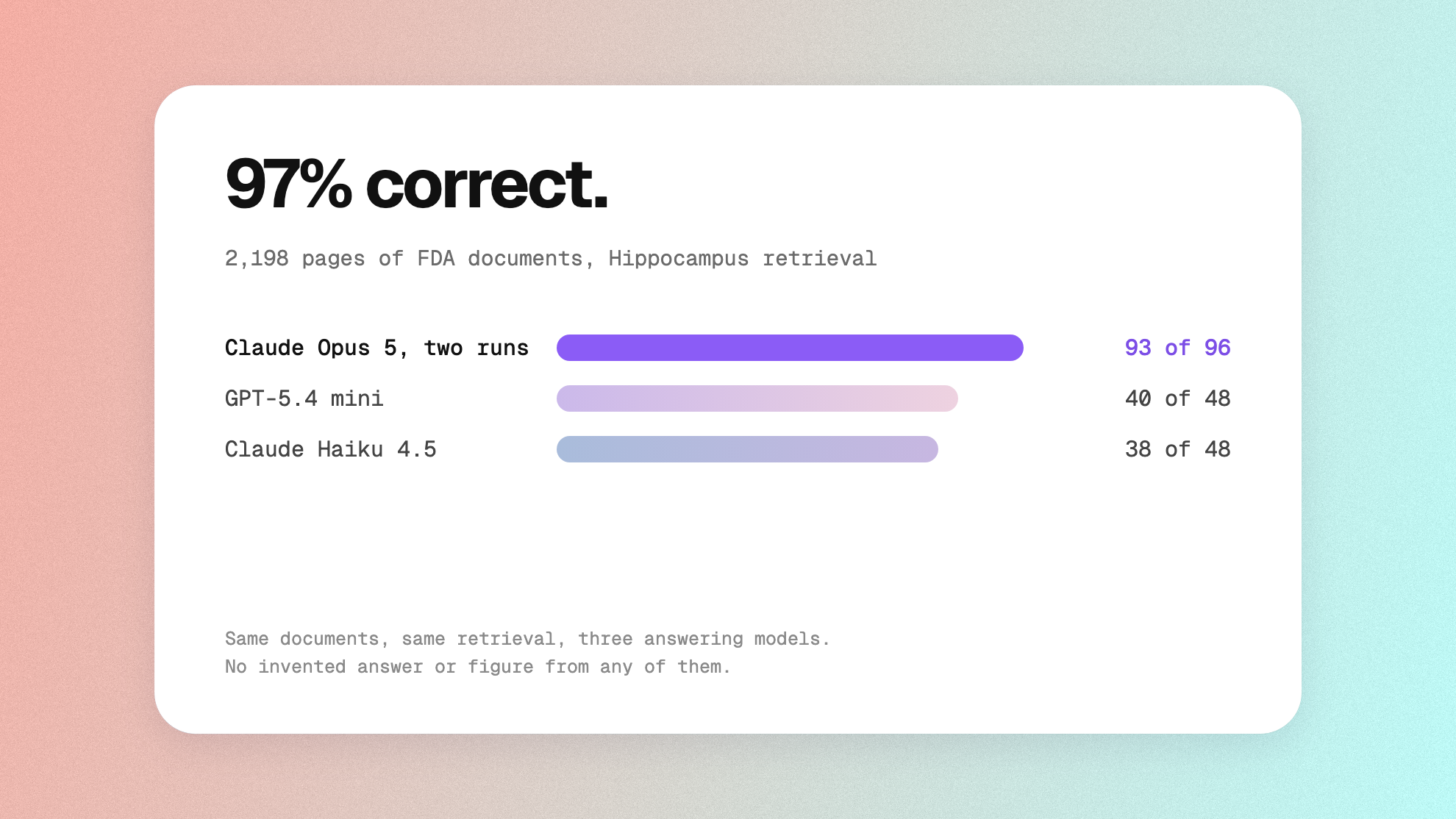
- 93 of 96 answers correct. Fifteen of sixteen questions right in every one of six repetitions.
- Zero invented answers or figures.
- The unanswerable question declined six times out of six. Asked to rank the therapies by time to generic competition, the system said what was missing instead of producing a plausible ranking.
- Every answer cited to document, section and page.
The three misses came from one question: which safety signals all three therapies share. The FDA files the same heart-rate finding under a different section for one of the three. Two of three frontier models answering from memory get it wrong. Hippocampus got it right 3 of 6 times, up from 1 of 6 on the previous release.
Correct answers in each full run
Each bar is one full run of the sixteen questions, each asked three times, with Claude Opus 5 answering: 93 of 96 together.
- One run 47 of 48
- The other run 46 of 48
Table view: every count behind the chart
| Name | Value |
|---|---|
| One run | 47 of 48 |
| The other run | 46 of 48 |
The one question with misses, by release
Each bar counts the right answers in six repetitions of the question on which safety signals all three therapies share.
- Hippocampus, this release 3 of 6
- Hippocampus, previous release 1 of 6
Table view: every count behind the chart
| Name | Value |
|---|---|
| Hippocampus, this release | 3 of 6 |
| Hippocampus, previous release | 1 of 6 |
Method
All ten documents are public. The questions and reference answers belong to Atrogi. Method, corpus and every question's score are on the benchmark page.
*Claude Opus 5 as answering model. 16 expert questions, each asked three times per repetition, full set run twice (96 answers), over 10 public FDA documents (2,198 pages) for three GLP-1 therapies. Thalius evaluation, 16 to 17 September 2026.